

Research Highlights

Research Highlights

The Human Frontiers in Science Program funds a collaborative project in Dr. Entcheva's Lab with researchers at Tokyo University in Japan and Leeds University in the UK to develop new ways to optogenetically control organelle interactions in human heart cells and their propensity to cardiac arrhythmias.

National Institutes of Health: Supported by multiple NIH grants, Dr. Luyao Lu is developing advanced heart-on-a-chip platforms and implantable cardiac bioelectronic devices to investigate the mechanisms of heart disease and enable the development of effective therapeutic strategies.

Working under an NSF CAREER grant, Dr. Chung Hyuk Park has created socially intelligent and adaptive human-robot interaction algorithms to facilitate long-term therapeutic intervention and user engagement. In a collaborative NSF grant, Dr. Park utilizes self-determination theory and intelligent robotic systems to design assistive industrial robotics environments that support and foster autistic talent in manufacturing.

Prof. Jason Zara is the PI of the Kern Family Foundation grant titled “Research for All (R4A)” with a goal of broadening participation in undergraduate research by developing entrepreneurially minded (EM)-focused undergraduate research frameworks and tools including EM-focused course-based engineering research experiences, EM-focused training modules, and online connection platforms.
Spotlight
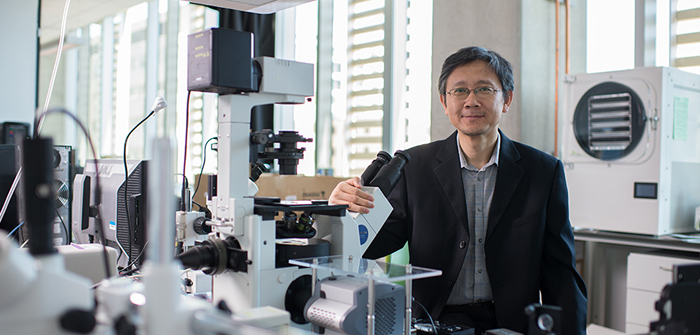
Studying Asthma
According to the Children’s National Health System, asthma is the leading, serious, chronic illness among children in the U.S., and it is the third-ranking cause of hospitalization for children under the age of 15.
Unfortunately, it also is often difficult to diagnose—and the mechanisms by which people develop asthma, or by which an asthma attack will occur, are not well understood. However, Dr. Zhenyu Li hopes that his research team will be able to shed light on these mechanisms through a project they are conducting under a four-year National Institutes of Health grant.
Dr. Li and his research group use micro- and nano-technologies to build medical devices that can be used for biological research or for disease diagnosis. He has made significant breakthroughs in designing “lab-on-a-chip” technologies to diagnose other diseases, and his current project builds on some of these previous successes.
“Asthma is a very complex condition, and there are a number of potential triggers for it, such as air pollution, smoke, exercise, pets, mold, and many others,” notes Dr. Li. “How the genetics of a particular individual and their behavior interact with the potential triggers is poorly understood.”
No research tools exist currently to allow researchers to objectively quantify the environmental factors with behaviors and biological response. To remedy this, Dr. Li’s team plans to deploy wearable and portable sensors into the daily life of the children who participate in this study to monitor their activity levels and their exposure to environmental triggers.
Because it is not possible to build a sensor that can monitor all the potential triggers of asthma, Dr. Li’s team is developing two sensors to monitor air pollution gases in the environment. The wearable sensor monitors formaldehyde—which is found in carpets, paints, tobacco smoke, and gas engine exhaust—and the ambient temperature and humidity. The portable sensor monitors ozone and nitrogen dioxide.
Dr. Li cautions that the sensors are not being developed for commercial use. “This is a research tool. Our goal is to develop a deployable sensor set for pediatric asthma researchers to use in their clinical studies,” he explains.
The team already has developed the prototypes for both the wearable and portable sensors, and they have tested the sensors’ performance in the labs. The sensors have performed well, detecting the relevant concentration ranges for the target gases that are normally present in a city environment. Now the team is working with participants in the study to test the sensors’ usability and their performance outside the lab. Dr. Li collaborates on this project with Dr. Mona Zaghloul of the Department of Electrical and Computer Engineering, and Dr. Dinesh Pillai of the Department of Pediatrics and Integrative Systems Biology and Children’s National Medical Center.