

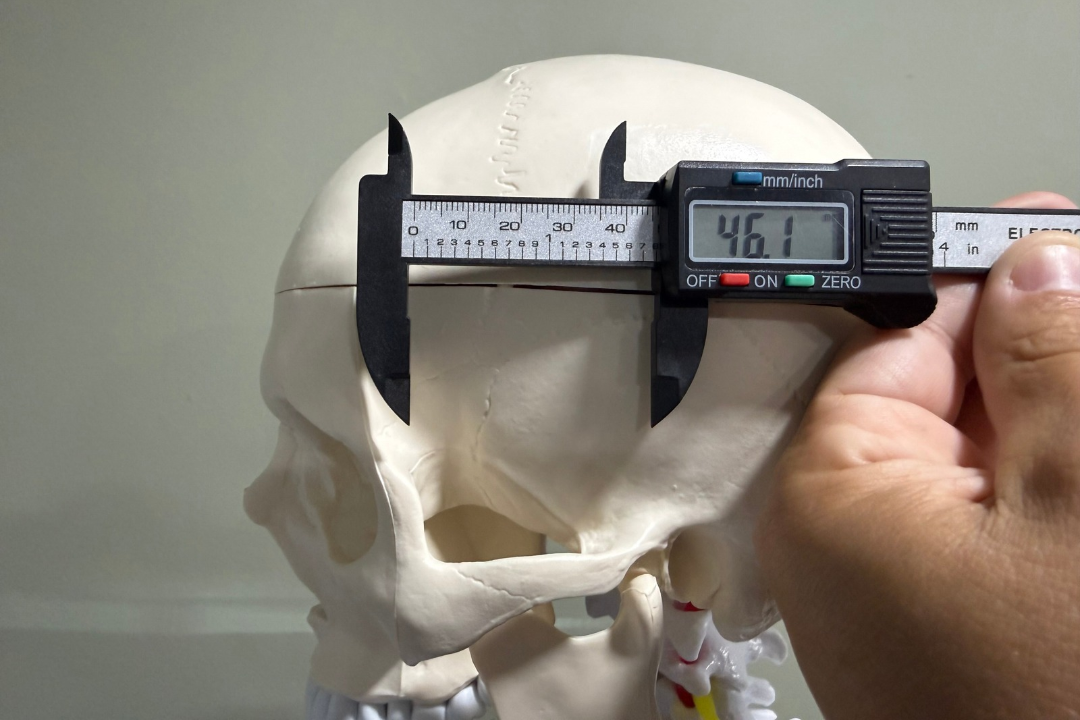
When Kevin Horrigan began his doctoral studies in biomedical engineering (BME) at GW, he came with a problem to solve but no viable solution. He had seen countless traumatic brain injuries from blasts both in combat and training in his 20 years in the Army Special Forces. Still, he knew the military lacked the technology and knowledge to understand their immediate effects and how symptoms evolve.
Horrigan himself is rated 100% disabled by the U.S. Department of Veterans Affairs, but he says he’s one of the lucky ones. “Right now, the decision whether someone’s head injury is serious enough to stop training or pull them out of the field gets made with no objective measurement of the brain at all,” he said. “I knew that was the problem long before I knew what to build.”
Inspired by Dr. Shen Xu’s work at the University of California, San Diego, on a wearable ultrasound patch, Horrigan decided ultrasound was the way to approach this issue. He was working at the Defense Advanced Research Projects Agency when he presented his idea for using ultrasound to measure blood flow in the brain following blast exposure, recalling that leadership liked the idea but told him “it belonged in a university lab rather than an agency.”
This is what led him to GW Engineering, where BME Professor and Chair Vesna Zderic saw the potential and brought him into her Therapeutic Ultrasound Laboratory. While Horrigan had clear inspiration and knew what he wanted to measure, he had only a general idea of how to build it and no way to actually move from idea to product development. However, that quickly changed at GW Engineering.
“GW is where it went from a problem I could describe to hardware I could put on a bench and measure,” Horrigan stated.
Horrigan’s academic background before GW spans multiple disciplines, including a bachelor’s in applied mathematics and master’s degrees in astronautics and computer science. The innovative, noninvasive brain-monitoring platform he’s developing through his startup, Planck Technologies, draws on this background, as it’s more accessible than existing solutions not only for its portability but also for its use of machine-learning algorithms to analyze blood-flow waveforms automatically.
This work has also required Horrigan to get up to speed on areas he’s less familiar with, including biology itself. In fact, he took his first biology class since 1997 just last year when he enrolled in Zderic’s Anatomy and Physiology for Engineering course–a clear example of GW Engineering’s “Engineering and…” ethos. Classes at GW’s School of Medicine and Health Sciences (SMHS) have given him the additional medical knowledge he needs to develop his device.
“Whether it is how the FDA process actually works, or the function of the limbic system, the faculty and the students [in SMHS] have been patient about helping me catch up. I learn as much from other students as I do from faculty,” said Horrigan.
Within GW Engineering, Horrigan credits Dr. Bridget Thorpe, Ph.D. ‘26, and BME Professor Zhenyu Li with training him on the physical side of ultrasound testing. Thorpe’s dissertation defense showed him the benefits of building rather than buying some of the needed equipment, while Li taught him how to build his own printed circuit boards.
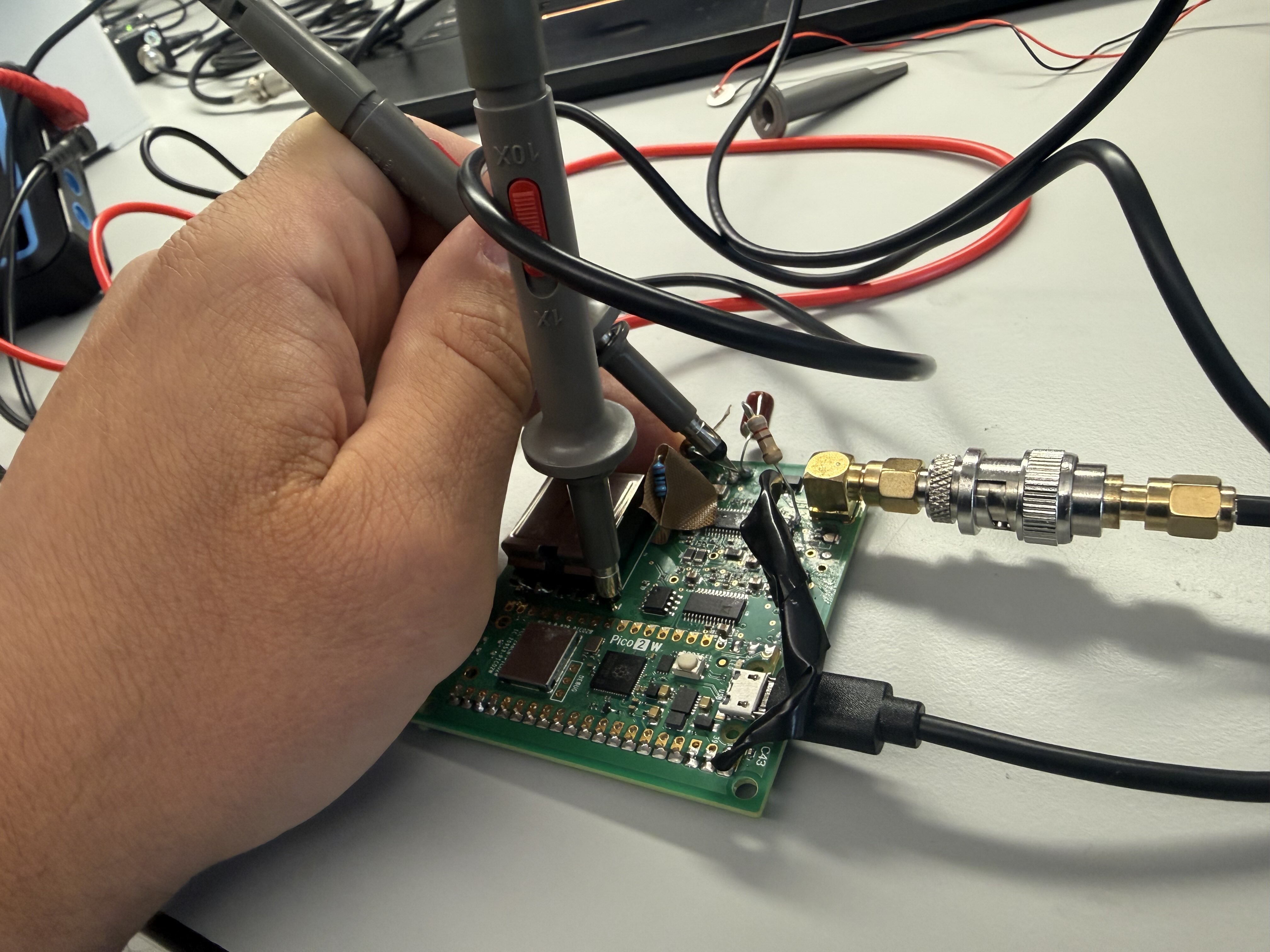
Horrigan specifically uses transcranial Doppler ultrasound to measure an individual’s cerebral blood flow. Thanks to the lab’s partnerships with Viasonix and Image Monitoring USA, he received one on loan for his work, underscoring the viability of his idea.
Ultimately, Horrigan aims for his device to be used in military environments and transform how they treat brain injuries by enabling earlier identification and triage, with secondary applications in civilian emergency care. To do this, he is combining engineering and entrepreneurship to simultaneously build and commercialize the device through his growing startup.
“Building the thing teaches you what you are actually selling, and it is usually not what you thought. Every honest measurement either narrows the claim or changes it. The other half is customer discovery, and I underestimated it,” said Horrigan. “Working in a startup before this taught me how much market fit matters. The real question is who your customer is and whether they actually want the thing you are making, and you only find that out by asking them.”
This process has highlighted the inherent tension between the roles of a researcher and an entrepreneur for Horrigan, as he notes that researchers are never done, whereas entrepreneurs see the utility in a design and can put a box around the time needed to bring it to market. Medicine straddles the two harder than most fields, with the process of getting approval from the U.S. Food and Drug Administration right in the middle.
Taking advantage of GW’s entrepreneurship ecosystem, Horrigan practiced sharing his idea with a general audience in GW’s 2026 New Venture Competition (NVC) and won 3rd place in the Health and Life Sciences Track. Zderic’s guidance, as well as the mentors he received through NVC and the National Science Foundation’s I-Corps program, has taught him things not covered in any of his classes.
Additionally, GW’s Technology Commercialization Office walked him through the patent process, helping him take one step closer to bringing this technology to the real world. His next steps are bench validation of acoustic performance, which is how easily ultrasound waves travel through the body, followed by initial volunteer testing under an approved protocol.
Horrigan’s journey exemplifies how GW Engineering empowers students to turn innovative ideas into successful ventures, and he encourages fellow students to use the available resources early as they pursue their own entrepreneurial paths.